what term is used in macroeconomics to describe the total supply and the total demand

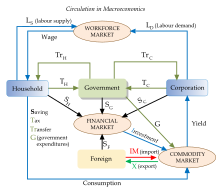
(Production bike and national income) Macroeconomics takes a big-motion-picture show view of the entire economy, including examining the roles of, and relationships between, corporations, governments and households, and the different types of markets, such as the financial market and the labour market place. However, the use of natural resources and the generation of waste (like greenhouse gases) are frequently forgotten in macroeconomic thinking and excluded in its models.
Macroeconomics (from the Greek prefix makro- significant "large" + economics) is a branch of economics dealing with functioning, structure, behavior, and controlling of an economy as a whole. For case, using interest rates, taxes, and government spending to regulate an economy's growth and stability.[1] This includes regional, national, and global economies.[2] [iii] According to a 2018 assessment by economists Emi Nakamura and Jón Steinsson, economic "evidence regarding the consequences of different macroeconomic policies is nonetheless highly imperfect and open to serious criticism."[4]
Macroeconomists study topics such as Gross domestic product (Gross domestic product), unemployment (including unemployment rates), national income, price indices, output, consumption, aggrandizement, saving, investment, energy, international trade, and international finance.
Macroeconomics and microeconomics are the two most general fields in economics.[5] The United Nations Sustainable Development Goal 17 has a target to enhance global macroeconomic stability through policy coordination and coherence as role of the 2030 Agenda.[vi]
Evolution [edit]
Origins [edit]
Macroeconomics descended from the once divided fields of business wheel theory and monetary theory.[7] The quantity theory of money was particularly influential prior to World War II. It took many forms, including the version based on the work of Irving Fisher:

In the typical view of the quantity theory, coin velocity (V) and the quantity of appurtenances produced (Q) would be constant, so any increase in money supply (M) would lead to a direct increase in price level (P). The quantity theory of money was a central function of the classical theory of the economic system that prevailed in the early twentieth century.
Austrian Schoolhouse [edit]
Ludwig Von Mises'southward piece of work Theory of Money and Credit, published in 1912, was one of the offset books from the Austrian School to deal with macroeconomic topics.
Keynes and his followers [edit]
Macroeconomics, at least in its modernistic grade,[eight] began with the publication of General Theory of Employment, Interest and Money [7] [9] written by John Maynard Keynes. When the Bang-up Low struck, classical economists had difficulty in explaining how goods could go unsold and workers could be left unemployed. In classical theory, prices and wages would drop until the marketplace cleared, and all goods and labor were sold. Keynes offered a new theory of economics that explained why markets might not articulate, which would evolve (later in the 20th century) into a group of macroeconomic schools of thought known as Keynesian economics – also chosen Keynesianism or Keynesian theory.
In Keynes' theory, the quantity theory bankrupt down because people and businesses tend to agree on to their cash in tough economic times – a phenomenon he described in terms of liquidity preferences. Keynes also explained how the multiplier consequence would magnify a pocket-sized decrease in consumption or investment and cause declines throughout the economy. Keynes also noted the office uncertainty and animal spirits can play in the economy.[8]
The generation following Keynes combined the macroeconomics of the General Theory with neoclassical microeconomics to create the neoclassical synthesis. Past the 1950s, most economists had accepted the synthesis view of the macroeconomy.[viii] Economists like Paul Samuelson, Franco Modigliani, James Tobin, and Robert Solow adult formal Keynesian models and contributed formal theories of consumption, investment, and money demand that fleshed out the Keynesian framework.[ten]
Monetarism [edit]
Milton Friedman updated the quantity theory of coin to include a office for money demand. He argued that the role of coin in the economy was sufficient to explain the Great Low, and that aggregate need oriented explanations were non necessary. Friedman as well argued that monetary policy was more effective than financial policy; nevertheless, Friedman doubted the government's ability to "fine-tune" the economic system with monetary policy. He more often than not favored a policy of steady growth in money supply instead of frequent intervention.[11]
Friedman also challenged the Phillips curve relationship between inflation and unemployment. Friedman and Edmund Phelps (who was non a monetarist) proposed an "augmented" version of the Phillips curve that excluded the possibility of a stable, long-run tradeoff between inflation and unemployment.[12] When the oil shocks of the 1970s created a loftier unemployment and loftier inflation, Friedman and Phelps were vindicated. Monetarism was particularly influential in the early 1980s. Monetarism fell out of favor when central banks institute it difficult to target money supply instead of interest rates as monetarists recommended. Monetarism also became politically unpopular when the central banks created recessions in order to tedious aggrandizement.
New classical [edit]
New classical macroeconomics further challenged the Keynesian schoolhouse. A key development in new classical thought came when Robert Lucas introduced rational expectations to macroeconomics. Prior to Lucas, economists had generally used adaptive expectations where agents were assumed to expect at the contempo past to brand expectations well-nigh the future. Nether rational expectations, agents are assumed to be more sophisticated. A consumer will not simply assume a 2% inflation rate simply because that has been the boilerplate the past few years; they will look at electric current monetary policy and economic weather to make an informed forecast. When new classical economists introduced rational expectations into their models, they showed that monetary policy could only have a limited bear upon.
Lucas besides made an influential critique of Keynesian empirical models. He argued that forecasting models based on empirical relationships would keep producing the same predictions even every bit the underlying model generating the data inverse. He advocated models based on fundamental economic theory that would, in principle, be structurally accurate as economies changed. Following Lucas'south critique, new classical economists, led by Edward C. Prescott and Finn E. Kydland, created real business concern cycle (RB C) models of the macro economy.[13]
RB C models were created past combining fundamental equations from neo-classical microeconomics. In order to generate macroeconomic fluctuations, RB C models explained recessions and unemployment with changes in technology instead of changes in the markets for goods or money. Critics of RB C models argue that money clearly plays an important role in the economy, and the idea that technological regress tin explicate recent recessions is implausible.[xiii] However, technological shocks are only the more prominent of a myriad of possible shocks to the system that tin can be modeled. Despite questions about the theory behind RB C models, they have clearly been influential in economic methodology.[14]
New Keynesian response [edit]
New Keynesian economists responded to the new classical schoolhouse by adopting rational expectations and focusing on developing micro-founded models that are immune to the Lucas critique. Stanley Fischer and John B. Taylor produced early on piece of work in this surface area by showing that monetary policy could exist effective even in models with rational expectations when contracts locked in wages for workers. Other new Keynesian economists, including Olivier Blanchard, Julio Rotemberg, Greg Mankiw, David Romer, and Michael Woodford, expanded on this work and demonstrated other cases where inflexible prices and wages led to budgetary and financial policy having real effects.
Similar classical models, new classical models had assumed that prices would be able to accommodate perfectly and budgetary policy would only lead to cost changes. New Keynesian models investigated sources of viscous prices and wages due to imperfect competition,[15] which would not adjust, assuasive monetary policy to impact quantities instead of prices.
Past the late 1990s, economists had reached a rough consensus. The nominal rigidity of new Keynesian theory was combined with rational expectations and the RBC methodology to produce dynamic stochastic general equilibrium (DSGE) models. The fusion of elements from dissimilar schools of thought has been dubbed the new neoclassical synthesis. These models are now used past many cardinal banks and are a cadre part of contemporary macroeconomics.[xvi]
New Keynesian economic science, which developed partly in response to new classical economics, strives to provide microeconomic foundations to Keynesian economics past showing how imperfect markets can justify demand management.
Macroeconomic models [edit]
Aggregate need–aggregate supply [edit]

A traditional AS–Advert diagram showing a shift in AD and the AS curve becoming inelastic beyond potential output.
The Advertizing-AS model has become the standard textbook model for explaining the macroeconomy.[17] This model shows the price level and level of real output given the equilibrium in aggregate demand and aggregate supply. The aggregate demand bend's downwards slope means that more than output is demanded at lower price levels.[18] The downward slope is the result of three effects: the Pigou or real residuum effect, which states that as real prices autumn, real wealth increases, resulting in college consumer demand of goods; the Keynes or interest charge per unit effect, which states that as prices fall, the demand for money decreases, causing interest rates to decline and borrowing for investment and consumption to increase; and the cyberspace consign consequence, which states that as prices rise, domestic goods become comparatively more expensive to strange consumers, leading to a refuse in exports.[18]
In the conventional Keynesian use of the Equally-AD model, the aggregate supply curve is horizontal at low levels of output and becomes inelastic well-nigh the point of potential output, which corresponds with full employment.[17] Since the economy cannot produce across the potential output, any Advertizing expansion will lead to college price levels instead of higher output.
The Advertising–Every bit diagram can model a variety of macroeconomic phenomena, including inflation. Changes in the not-price level factors or determinants cause changes in aggregate need and shifts of the entire aggregate demand (Advertizing) curve. When demand for goods exceeds supply, at that place is an inflationary gap where demand-pull inflation occurs and the AD curve shifts upward to a higher price level. When the economy faces higher costs, cost-push inflation occurs and the AS curve shifts upward to higher toll levels.[19] The AS–Advertising diagram is also widely used as an instructive tool to model the effects of various macroeconomic policies.[twenty]
IS-LM [edit]

In this example of an IS/LM chart, the IS curve moves to the right, causing higher interest rates (i) and expansion in the "existent" economy (real Gross domestic product, or Y).
The IS–LM model gives the underpinnings of aggregate demand (itself discussed higher up). It answers the question "At any given price level, what is the quantity of goods demanded?". This model shows what combination of interest rates and output will ensure equilibrium in both the goods and money markets.[21] The goods market is modeled as giving equality betwixt investment and public and private saving (IS), and the money market place is modeled as giving equilibrium between the money supply and liquidity preference.[22]
The IS bend consists of the points (combinations of income and involvement rate) where investment, given the interest rate, is equal to public and private saving, given output[23] The IS curve is down sloping because output and the interest rate have an inverse relationship in the appurtenances market place: as output increases, more income is saved, which means involvement rates must be lower to spur plenty investment to match saving.[23]
The LM curve is upwardly sloping because the interest rate and output accept a positive relationship in the money market: every bit income (identically equal to output) increases, the need for money increases, resulting in a rising in the interest rate in society to merely offset the incipient rise in money demand.[24]
The IS-LM model is oftentimes used to demonstrate the effects of budgetary and fiscal policy.[21] Textbooks frequently utilise the IS-LM model, but it does not feature the complexities of almost modern macroeconomic models.[21] Withal, these models still feature similar relationships to those in IS-LM.[21]
Growth models [edit]
The neoclassical growth model of Robert Solow has become a common textbook model for explaining economic growth in the long-run.[25] The model begins with a production function where national output is the product of ii inputs: capital and labor. The Solow model assumes that labor and capital are used at constant rates without the fluctuations in unemployment and capital utilization usually seen in business organisation cycles.[26]
An increase in output, or economic growth, can only occur because of an increase in the capital stock, a larger population, or technological advancements that lead to higher productivity (full factor productivity). An increment in the savings rate leads to a temporary increase as the economy creates more than capital, which adds to output. Withal, eventually the depreciation rate will limit the expansion of capital: savings volition be used up replacing depreciated uppercase, and no savings will remain to pay for an additional expansion in capital. Solow's model suggests that economic growth in terms of output per capita depends solely on technological advances that raise productivity.[27]
In the 1980s and 1990s endogenous growth theory arose to claiming neoclassical growth theory. This group of models explains economic growth through other factors, such as increasing returns to calibration for upper-case letter and learning-by-doing, that are endogenously determined instead of the exogenous technological improvement used to explain growth in Solow's model.[28]
Humanity's economical system as a subsystem of the global environment [edit]
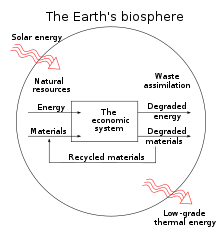
Natural resources period through the economy and terminate up as waste material and pollution
In the macroeconomic models in ecological economics, the economic system is a subsystem of the environment. In this model, the circular menstruation of income diagram is replaced in ecological economics by a more than circuitous menstruum diagram reflecting the input of solar energy, which sustains natural inputs and environmental services which are and so used every bit units of product. Once consumed, natural inputs pass out of the economy equally pollution and waste. The potential of an environment to provide services and materials is referred to as an "surroundings's source part", and this function is depleted as resource are consumed or pollution contaminates the resources. The "sink function" describes an environment'southward ability to absorb and render harmless waste and pollution: when waste output exceeds the limit of the sink function, long-term impairment occurs.[29] : viii Some persistent pollutants, such as some organic pollutants and nuclear waste are captivated very slowly or non at all; ecological economists emphasize minimizing "cumulative pollutants".[29] : 28 Pollutants touch man health and the wellness of the ecosystem.
Basic macroeconomic concepts [edit]
Macroeconomics encompasses a multifariousness of concepts and variables, just in that location are three central topics for macroeconomic research.[30] Macroeconomic theories commonly relate the phenomena of output, unemployment, and inflation. Outside of macroeconomic theory, these topics are likewise important to all economic agents including workers, consumers, and producers.
Output and income [edit]
National output is the total corporeality of everything a country produces in a given period of time. Everything that is produced and sold generates an equal corporeality of income. The total output of the economy is measured GDP per person. The output and income are usually considered equivalent and the 2 terms are often used interchangeably, output changes into income. Output can be measured or information technology can be viewed from the production side and measured as the total value of concluding goods and services or the sum of all value added in the economy.[31]
Macroeconomic output is usually measured by gross domestic production (Gross domestic product) or one of the other national accounts. Economists interested in long-run increases in output, study economic growth. Advances in technology, aggregating of machinery and other capital, and ameliorate teaching and human capital, are all factors that lead to increase economic output over time. However, output does non always increase consistently over time. Concern cycles can crusade short-term drops in output chosen recessions. Economists look for macroeconomic policies that forbid economies from slipping into recessions, and that lead to faster long-term growth.
Unemployment [edit]
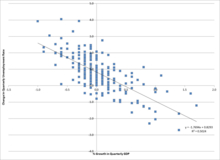
A nautical chart using US information showing the relationship betwixt economic growth and unemployment expressed by Okun'south law. The relationship demonstrates cyclical unemployment. Economic growth leads to a lower unemployment rate.
The amount of unemployment in an economy is measured by the unemployment rate, i.e. the percentage of workers without jobs in the labor force. The unemployment rate in the labor force only includes workers actively looking for jobs. People who are retired, pursuing educational activity, or discouraged from seeking work by a lack of job prospects are excluded.
Unemployment can be generally broken down into several types that are related to different causes.
- Classical unemployment theory suggests that unemployment occurs when wages are too high for employers to be willing to hire more workers.[32] Other more modernistic economical theories[ which? ] suggest that increased wages actually decrease unemployment by creating more consumer demand. According to these more contempo theories, unemployment results from reduced demand for the goods and services produced through labor and suggest that merely in markets where profit margins are very low, and in which the market place will not bear a toll increment of product or service, will higher wages result in unemployment.
- Consequent with classical unemployment theory, frictional unemployment occurs when appropriate chore vacancies exist for a worker, but the length of time needed to search for and find the job leads to a period of unemployment.[33]
- Structural unemployment covers a variety of possible causes of unemployment including a mismatch between workers' skills and the skills required for open jobs.[34] Large amounts of structural unemployment commonly occur when an economic system shifts to focus on new industries and workers find their previous set up of skills are no longer in demand. Structural unemployment is similar to frictional unemployment as both reflect the problem of matching workers with chore vacancies, only structural unemployment also covers the time needed to acquire new skills in improver to the curt-term search process.[35]
- While some types of unemployment may occur regardless of the condition of the economy, cyclical unemployment occurs when growth stagnates. Okun'southward constabulary represents the empirical relationship between unemployment and economic growth.[36] The original version of Okun'south law states that a three% increase in output would lead to a ane% decrease in unemployment.[37]
Inflation and deflation [edit]
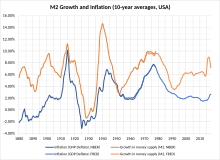
Changes in the ten-year moving averages of price level and growth in money supply (using the measure of M2, the supply of difficult currency and money held in most types of bank accounts) in the The states from 1880 to 2016. Over the long run, the two serial show a close human relationship.
A general price increase across the unabridged economy is chosen aggrandizement. When prices subtract, there is deflation. Economists measure out these changes in prices with price indexes. Aggrandizement tin occur when an economic system becomes overheated and grows too apace. Similarly, a declining economy tin lead to deflation.
Central bankers, who manage a country'south money supply, try to avoid changes in price level by using monetary policy. Raising interest rates or reducing the supply of coin in an economy will reduce inflation. Inflation tin can lead to increased uncertainty and other negative consequences. Deflation can lower economical output. Cardinal bankers try to stabilize prices to protect economies from the negative consequences of toll changes.
Changes in cost level may be the consequence of several factors. The quantity theory of money holds that changes in cost level are directly related to changes in the money supply. About economists believe that this relationship explains long-run changes in the price level.[38] Short-run fluctuations may also be related to budgetary factors, merely changes in aggregate demand and aggregate supply can also influence price level. For example, a decrease in demand due to a recession tin can lead to lower price levels and deflation. A negative supply shock, such as an oil crisis, lowers aggregate supply and tin can cause inflation.
Macroeconomic policy [edit]
Macroeconomic policy is normally implemented through two sets of tools: fiscal and monetary policy. Both forms of policy are used to stabilize the economic system, which tin hateful boosting the economic system to the level of GDP consistent with full employment.[39] Macroeconomic policy focuses on limiting the effects of the business cycle to attain the economic goals of cost stability, total employment, and growth.[40]
Co-ordinate to a 2018 cess past economists Emi Nakamura and Jón Steinsson, economic "evidence regarding the consequences of unlike macroeconomic policies is yet highly imperfect and open to serious criticism."[4] Nakamura and Steinsson write that macroeconomics struggles with long-term predictions, which is a result of the high complexity of the systems it studies.[iv]
Monetary policy [edit]
Key banks implement monetary policy by controlling the money supply through several mechanisms. Typically, primal banks take action by issuing money to purchase bonds (or other assets), which boosts the supply of coin and lowers interest rates, or, in the case of contractionary monetary policy, banks sell bonds and take money out of circulation. Commonly policy is not implemented by direct targeting the supply of money.
Central banks continuously shift the money supply to maintain a targeted stock-still interest rate. Some of them let the involvement charge per unit to fluctuate and focus on targeting aggrandizement rates instead. Central banks generally attempt to achieve high output without letting loose monetary policy that create large amounts of inflation.
Conventional monetary policy tin can be ineffective in situations such as a liquidity trap. When interest rates and inflation are near zero, the fundamental depository financial institution cannot loosen monetary policy through conventional means.
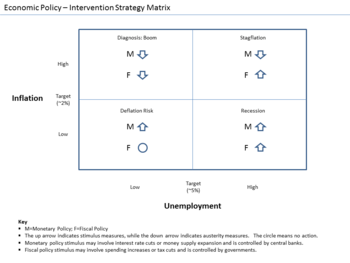
An example of intervention strategy under different conditions
Primal banks tin utilise unconventional budgetary policy such as quantitative easing to help increase output. Instead of buying government bonds, primal banks can implement quantitative easing by buying non only regime bonds, simply also other avails such as corporate bonds, stocks, and other securities. This allows lower interest rates for a broader class of assets beyond government bonds. In another example of unconventional monetary policy, the United States Federal Reserve recently made an try at such a policy with Functioning Twist. Unable to lower current interest rates, the Federal Reserve lowered long-term interest rates past ownership long-term bonds and selling brusque-term bonds to create a flat yield bend.
Financial policy [edit]
Fiscal policy is the use of authorities's revenue and expenditure equally instruments to influence the economy. Examples of such tools are expenditure, taxes, debt.
For instance, if the economic system is producing less than potential output, government spending can be used to utilise idle resource and heave output. Regime spending does not have to brand up for the entire output gap. In that location is a multiplier effect that boosts the impact of authorities spending. For instance, when the government pays for a span, the project not merely adds the value of the bridge to output, simply as well allows the bridge workers to increase their consumption and investment, which helps to close the output gap.
The effects of fiscal policy can be limited past crowding out. When the government takes on spending projects, it limits the corporeality of resources available for the individual sector to use. Crowding out occurs when government spending only replaces private sector output instead of adding additional output to the economy. Crowding out too occurs when government spending raises interest rates, which limits investment. Defenders of fiscal stimulus argue that crowding out is non a concern when the economy is depressed, plenty of resources are left idle, and interest rates are low.[41] [42]
Fiscal policy can be implemented through automatic stabilizers. Automatic stabilizers do non suffer from the policy lags of discretionary financial policy. Automatic stabilizers use conventional financial mechanisms simply take effect as soon as the economy takes a downturn: spending on unemployment benefits automatically increases when unemployment rises and, in a progressive income tax system, the effective taxation rate automatically falls when incomes decline.
Comparison [edit]
Economists usually favor monetary over fiscal policy because information technology has two major advantages. Beginning, monetary policy is generally implemented by independent cardinal banks instead of the political institutions that control fiscal policy. Independent primal banks are less probable to make decisions based on political motives.[39] Second, monetary policy suffers shorter inside lags and outside lags than fiscal policy. Primal banks can quickly make and implement decisions while the discretionary fiscal policy may take time to pass and fifty-fifty longer to bear out.[39]
See likewise [edit]
- Dynamic stochastic general equilibrium
- Economic evolution
Notes [edit]
- ^ Samuelson, Robert (2020), "Goodbye, readers, and expert luck — you'll need it", The Washington Post This article was an opinion piece expressing despondency in the field before long before his retirement, but information technology'south however a practiced summary.
- ^ O'Sullivan, Arthur; Sheffrin, Steven M. (2003), Economics: Principles in Action, Upper Saddle River, New Bailiwick of jersey 07458: Pearson Prentice Hall, p. 57, ISBN978-0-13-063085-8
{{citation}}: CS1 maint: location (link) - ^ Steve Williamson, Notes on Macroeconomic Theory, 1999
- ^ a b c Nakamura, Emi; Steinsson, Jón (2018). "Identification in Macroeconomics". Periodical of Economic Perspectives. 32 (iii): 59–86. doi:ten.1257/jep.32.3.59. ISSN 0895-3309. S2CID 44180952.
- ^ Blaug, Mark (1985), Economic theory in retrospect, Cambridge: Cambridge University Press, ISBN978-0-521-31644-6
- ^ "Goal 17 | Department of Economic and Social Diplomacy". sdgs.united nations.org . Retrieved 2020-09-26 .
- ^ a b Dimand (2008).
- ^ a b c Blanchard (2011), 580.
- ^ Snowdon, Brian; Vane, Howard R. (2005). Mod Macroeconomics – Its origins, development and current land. Edward Elgar. ISBN1-84542-208-2.
- ^ Blanchard (2011), 581.
- ^ Blanchard (2011), 582–83.
- ^ "Phillips Curve: The Concise Encyclopedia of Economics | Library of Economics and Liberty". www.econlib.org . Retrieved 2018-01-23 .
- ^ a b Blanchard (2011), 587.
- ^ Kariappa Bheemaiah, The Blockchain Alternative: Rethinking Macroeconomic Policy and Economic Theory (Dordrecht NL: Apress/Springer Nature, 2017), 169-70. ISBN 1484226747, 9781484226742
- ^ The part of imperfect contest in new Keynesian economic science, Chapter four of Surfing Economic science past Huw Dixon
- ^ Blanchard (2011), 590.
- ^ a b Healey 2002, p. 12.
- ^ a b Healey 2002, p. 13.
- ^ Healey 2002, p. 14.
- ^ Colander 1995, p. 173. sfn error: no target: CITEREFColander1995 (assistance)
- ^ a b c d Durlauf & Hester 2008.
- ^ Peston 2002, pp. 386–87.
- ^ a b Peston 2002, p. 387.
- ^ Peston 2002, pp. 387–88.
- ^ Banton, Caroline. "The Neoclassical Growth Theory Explained". Investopedia . Retrieved 2020-09-21 .
- ^ Solow 2002, pp. 518–19.
- ^ Solow 2002, p. 519.
- ^ Blaug 2002, pp. 202–03.
- ^ a b Harris J. (2006). Ecology and Natural Resource Economics: A Contemporary Approach. Houghton Mifflin Visitor.
- ^ Blanchard (2011), 32.
- ^ Blanchard (2011), 22.
- ^ Pettinger, Tejvan. "Involuntary unemployment". Economics Help . Retrieved 2020-09-21 .
- ^ Dwivedi, 443.
- ^ "Freeman (2008)".
- ^ Dwivedi, 444–45.
- ^ Dwivedi, 445–46.
- ^ "Neely, Christopher J. "Okun'south Police: Output and Unemployment. Economic Synopses. Number 4. 2010".
- ^ Mankiw 2014, p. 634.
- ^ a b c Mayer, 495.
- ^ "AP Macroeconomics Review".
- ^ Ye, Fred Y. (2017). Scientific Metrics: Towards Belittling and Quantitative Sciences. Springer. ISBN978-981-10-5936-0.
- ^ Arestis, Philip; Sawyer, Malcolm (2003). "Reinventing fiscal policy" (PDF). Levy Economics Institute of Bard Higher (Working Paper, No. 381). Retrieved 7 December 2018.
References [edit]
- Blanchard, Olivier (2000). Macroeconomics. Prentice Hall. ISBN978-0-thirteen-013306-9.
- Blanchard, Olivier. (2009). "The State of Macro." Annual Review of Economics i(one): 209-228.
- Blanchard, Olivier (2011). Macroeconomics Updated (5th ed.). Englewood Cliffs: Prentice Hall. ISBN978-0-xiii-215986-nine.
- Blaug, Mark (1986), Great Economists before Keynes, Brighton: Wheatsheaf.
- Blaug, Mark (2002). "Endogenous growth theory". In Snowdon, Brian; Vane, Howard (eds.). An Encyclopedia of Macroeconomics . Northampton, Massachusetts: Edward Elgar Publishing. ISBN978-1-84542-180-nine.
- Boettke, Peter (2001). Calculation and Coordination: Essays on Socialism and Transitional Political Economy. Routledge. ISBN978-0-415-77109-two.
- Bouman, John: Principles of Macroeconomics – free fully comprehensive Principles of Microeconomics and Macroeconomics texts. Columbia, Maryland, 2011
- Dimand, Robert W. (2008). "Macroeconomics, origins and history of". In Durlauf, Steven N.; Blume, Lawrence East. (eds.). The New Palgrave Lexicon of Economics. Palgrave Macmillan UK. pp. 236–44. doi:10.1057/9780230226203.1009. ISBN978-0-333-78676-5 http://world wide web.dictionaryofeconomics.com/article?id=pde2008_M000370.
- Durlauf, Steven North.; Hester, Donald D. (2008). "IS–LM". In Durlauf, Steven N.; Blume, Lawrence E. (eds.). The New Palgrave Dictionary of Economics (2nd ed.). Palgrave Macmillan. pp. 585–91. doi:ten.1057/9780230226203.0855. ISBN978-0-333-78676-five . Retrieved 5 June 2012.
- Dwivedi, D.N. (2001). Macroeconomics: theory and policy. New Delhi: Tata McGraw-Hill. ISBN978-0-07-058841-7.
- Friedman, Milton (1953). Essays in Positive Economics . London: University of Chicago Press. ISBN978-0-226-26403-5.
- Haberler, Gottfried (1937). Prosperity and depression. League of Nations.
- Leijonhufvud, Axel The Wicksell Connection: Variation on a Theme. UCLA. November, 1979.
- Healey, Nigel One thousand. (2002). "Advertizing-AS model". In Snowdon, Brian; Vane, Howard (eds.). An Encyclopedia of Macroeconomics . Northampton, Massachusetts: Edward Elgar Publishing. pp. 11–xviii. ISBN978-i-84542-180-9.
- Heijdra, Ben J.; van der Ploeg, Frederick (2002). Foundations of Modernistic Macroeconomics. Oxford Academy Press. ISBN978-0-19-877617-8.
- Mankiw, N. Gregory (2014). Principles of Economics. Cengage Learning. ISBN978-i-305-15604-iii.
- Mises, Ludwig Von (1912). Theory of Money and Credit. Yale University Press.
- Mayer, Thomas (2002). "Monetary policy: office of". In Snowdon, Brian; Vane, Howard R. (eds.). An Encyclopedia of Macroeconomics . Northampton, Massachusetts: Edward Elgar Publishing. pp. 495–99. ISBN978-1-84542-180-9.
- Mishkin, Frederic Due south. (2004). The Economics of Money, Banking, and Fiscal Markets . Boston: Addison-Wesley. p. 517. ISBN9780321122353.
- Nakamura, Emi and Jón Steinsson. (2018). "Identification in Macroeconomics." Journal of Economic Perspectives 32(3): 59-86.
- Peston, Maurice (2002). "IS-LM model: closed economy". In Snowdon, Brian; Vane, Howard R. (eds.). An Encyclopedia of Macroeconomics . Edward Elgar. ISBN9781840643879.
- Reed, Jacob (2016). AP Economic science Review, Macroeconomics.
- Solow, Robert (2002). "Neoclassical growth model". In Snowdon, Brian; Vane, Howard (eds.). An Encyclopedia of Macroeconomics . Northampton, Massachusetts: Edward Elgar Publishing. ISBN1840643870.
- Snowdon, Brian, and Howard R. Vane, ed. (2002). An Encyclopedia of Macroeconomics, Clarification & whorl to Contents-preview links.
- Snowdon, Brian; Vane, Howard R. (2005). Modernistic Macroeconomics: Its Origins, Development And Electric current State. Edward Elgar Publishing. ISBN1845421809.
- Gärtner, Manfred (2006). Macroeconomics. Pearson Instruction Limited. ISBN978-0-273-70460-7.
- Warsh, David (2006). Knowledge and the Wealth of Nations . Norton. ISBN978-0-393-05996-0.
- Levi, Maurice (2014). The Macroeconomic Environment of Business (Cadre Concepts and Curious Connections). New Jersey: World Scientific Publishing. ISBN978-981-4304-34-four.
Source: https://en.wikipedia.org/wiki/Macroeconomics
0 Response to "what term is used in macroeconomics to describe the total supply and the total demand"
Post a Comment