When You First Get a Kidney Stone When Will You Get It Again
A kidney rock is a solid mass made up of tiny crystals. One or more stones can be in the kidney or ureter at the same fourth dimension.
Kidney stones are common. Some types run in families. They oft occur in premature infants.
There are different types of kidney stones. The cause of the problem depends on the type of stone.
Stones can grade when urine contains too much of certain substances that class crystals. These crystals tin develop into stones over weeks or months.
- Calcium stones are most mutual. They are most likely to occur in men between ages xx to xxx. Calcium tin can combine with other substances to form the rock.
- Oxalate is the most mutual of these. Oxalate is present in sure foods such as spinach. It is also found in vitamin C supplements. Diseases of the minor intestine increase your run a risk for these stones.
Calcium stones can likewise form from combining with phosphate or carbonate.
Other types of stones include:
- Cystine stones can form in people who have cystinuria. This disorder runs in families. Information technology affects both men and women.
- Struvite stones are mostly found in men or women who have repeated urinary tract infections. These stones can grow very big and can block the kidney, ureter, or float.
- Uric acid stones are more common in men than in women. They can occur with gout or chemotherapy.
- Other substances, such as certain medicines, as well tin form stones.
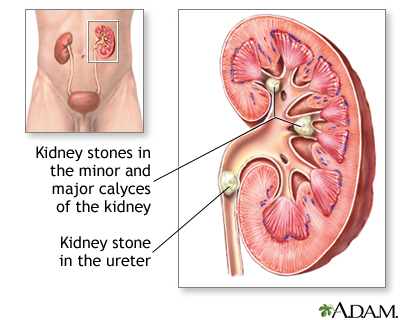
The biggest hazard gene for kidney stones is not drinking enough fluids. Kidney stones are more likely to occur if you make less than 1 liter (32 ounces) of urine a day.
You may non take symptoms until the stones movement down the tubes (ureters) through which urine empties into your bladder. When this happens, the stones tin block the menstruation of urine out of the kidneys.
The main symptom is severe pain that starts and stops suddenly:
- Pain may be felt in the belly area or side of the dorsum.
- Hurting may movement to the groin area (groin pain), testicles (testicle pain) in men, and labia (vaginal pain) in women.
Other symptoms can include:
- Abnormal urine color
- Claret in the urine
- Chills
- Fever
- Nausea and vomiting
Treatment depends on the type of rock and the severity of your symptoms.
Kidney stones that are small virtually oftentimes laissez passer through your system on their own.
- Your urine should exist strained and so the stone can be saved and tested.
- Drinkable at to the lowest degree vi to 8 glasses of water per day to produce a large amount of urine. This volition assist the stone pass.
- Pain can be very bad. Over-the-counter pain medicines (for instance, ibuprofen and naproxen), either alone or forth with narcotics, can exist very constructive.
Some people with severe pain from kidney stones demand to stay in the hospital. Y'all may need to get fluids through an IV into your vein.
For some types of stones, your provider may prescribe medicine to prevent stones from forming or assistance break down and remove the fabric that is causing the stone. These medicines can include:
- Allopurinol (for uric acrid stones)
- Antibiotics (for struvite stones)
- Diuretics (water pills)
- Phosphate solutions
- Sodium bicarbonate or sodium citrate
- Water pills (thiazide diuretics)
- Tamsulosin to relax the ureter and help the stone pass
Surgery is frequently needed if:
- The stone is too large to pass on its own.
- The stone is growing.
- The stone is blocking urine menses and causing an infection or kidney damage.
- The pain cannot be controlled.
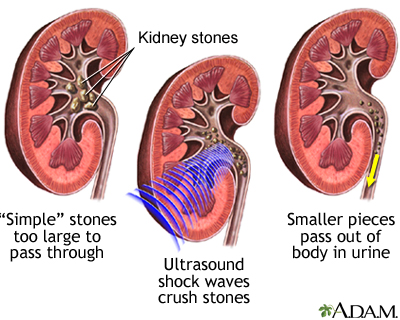
Today, virtually treatments are much less invasive than in the past.
- Lithotripsy is used to remove stones slightly smaller than one half an inch (1.25 centimeters) that are located in the kidney or ureter. It uses sound or shock waves to break upward stones into tiny fragments. Then, the rock fragments leave the trunk in the urine. Information technology is likewise called extracorporeal stupor-moving ridge lithotripsy or ESWL.
- Procedures performed by passing a special instrument through a small surgical cut in your skin on your dorsum and into your kidney or ureters are used for large stones, or when the kidneys or surrounding areas are incorrectly formed. The stone is removed with a tube (endoscope).
- Ureteroscopy may be used for stones in the lower urinary tract. A laser is used to break upwardly the stone.
- Rarely, open up surgery (nephrolithotomy) may be needed if other methods practice not piece of work or are non possible.
Talk to your provider about what treatment options may piece of work for you.
You will need to accept self-care steps. Which steps you lot take depend on the blazon of stone you have, but they may include:
- Drinking actress h2o and other liquids
- Eating more of some foods and cutting back on other foods
- Taking medicines to help preclude stones
- Taking medicines to help you lot pass a stone (anti-inflammatory drugs, alpha-blockers)
Kidney stones are painful, just most of the time can be removed from the torso without causing lasting damage.
Kidney stones often come back. This occurs more often if the cause is not found and treated.
Yous are at gamble for:
- Urinary tract infection
- Kidney damage or scarring if treatment is delayed for too long
Complication of kidney stones may include the obstruction of the ureter (astute unilateral obstructive uropathy).
Telephone call your provider if you accept symptoms of a kidney stone:
- Severe hurting in your back or side that will not go away
- Blood in your urine
- Fever and chills
- Vomiting
- Urine that smells bad or looks cloudy
- A burning feeling when y'all urinate
If you have been diagnosed with blockage from a rock, passage must be confirmed either by capture in a strainer during urination or by follow-up x-ray. Being pain free does not confirm that the stone has passed.
If you have a history of stones:
- Drink plenty of fluids (6 to eight glasses of h2o per solar day) to produce enough urine.
- Y'all may need to take medicine or make changes to your nutrition for some types of stones.
- Your provider may desire to practise claret and urine tests to assistance determine the proper prevention steps.
Renal calculi; Nephrolithiasis; Stones - kidney; Calcium oxalate - stones; Cystine - stones; Struvite - stones; Uric acid - stones; Urinary lithiasis
American Urological Association website. Medical direction of kidney stones (2019). www.auanet.org/guidelines/kidney-stones-medical-mangement-guideline. Accessed Feb 13, 2020.
American Urological Association website. Surgical management of stones: AUA/Endourology Order guideline (2016) www.auanet.org/guidelines/kidney-stones-surgical-management-guideline. Accessed Feb xiii, 2020.
Bushinsky DA. Nephrolithiasis. In: Goldman Fifty, Schafer AI, eds. Goldman-Cecil Medicine. 26th ed. Philadelphia, PA: Elsevier; 2020:chap 117.
Fink HA, Wilt TJ, Eidman KE, et al. Recurrent nephrolithiasis in adults: comparative effectiveness of preventive medical strategies. Rockville, MD. Agency for Healthcare Research and Quality (US) 2012;Study No.:12-EHC049-EF. PMID: 22896859 pubmed.ncbi.nlm.nih.gov/22896859/.
Miller NL, Borofsky MS. Evaluation and medical management of urinary lithiasis. In: Partin AW, Dmochowski RR, Kavoussi LR, Peters CA, eds. Campbell-Walsh-Wein Urology. 12th ed. Philadelphia, PA: Elsevier; 2021:chap 92.
Qaseem A, Dallas P, Forciea MA, Starkey M, Denberg TD; Clinical Guidelines Committee of the American Higher of Physicians. Dietary and pharmacologic management to preclude recurrent nephrolithiasis in adults: a clinical practice guideline from the American College of Physicians. Ann Intern Med. 2014;161(9):659-667. PMID: 25364887 pubmed.ncbi.nlm.nih.gov/25364887/.
Ziemba JB, Matlaga BR. Guideline of guidelines: kidney stones. BJU Int. 2015;116(2):184-189. PMID: 25684222. pubmed.ncbi.nlm.nih.gov/25684222/.
Updated by: Sovrin G. Shah, MD, Assistant Professor, Department of Urology, The Icahn School of Medicine at Mount Sinai, New York, NY. Review provided past VeriMed Healthcare Network. Likewise reviewed by David Zieve, Doc, MHA, Medical Managing director, Brenda Conaway, Editorial Director, and the A.D.A.M. Editorial squad.
Source: https://medlineplus.gov/ency/article/000458.htm
0 Response to "When You First Get a Kidney Stone When Will You Get It Again"
Post a Comment